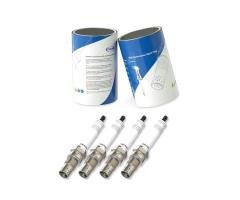
A pre-chamber spark plug is designed for use in an engine’s pre-combustion (pre-chamber) system, where ignition takes place in a small chamber before the flame spreads into the main combustion chamber. This design improves combustion efficiency, stability, and overall engine performance, especially in high-pressure gas engines.
The spark plug ignites the air-fuel mixture inside the pre-chamber.
The energy release is distributed through multiple small jets into the main combustion chamber.
This creates a more controlled and efficient combustion process.
Improved ignition control through pre-chamber combustion
Better fuel concentration at the spark gap for efficient ignition
Lower electrode temperature during operation
Reduced electrode wear and erosion
Longer service life compared to conventional spark plugs
Lower required operating voltage in high-pressure engines
High resistance to misfires and short circuits
Reliable performance even in humid or moist conditions
Enhanced combustion stability and efficiency
Increased engine safety and reliability
Reduced maintenance and replacement frequency
Improved performance in lean-burn gas engines
Lower emissions due to more complete combustion
Industrial gas engines
Power generation systems
Combined Heat and Power (CHP) plants
Biogas and landfill gas engines
High-pressure stationary engine applications
Pre-chamber spark plugs are widely used in modern gas engines due to their superior combustion control, durability, and reliable performance under demanding operating conditions.
Read moreA pre-chamber spark plug is designed for use in an engine’s pre-combustion (pre-chamber) system, where ignition takes place in a small chamber before the flame spreads into the main combustion chamber. This design improves combustion efficiency, stability, and overall engine performance, especially in high-pressure gas engines.
The spark plug ignites the air-fuel mixture inside the pre-chamber.
The energy release is distributed through multiple small jets into the main combustion chamber.
This creates a more controlled and efficient combustion process.
Improved ignition control through pre-chamber combustion
Better fuel concentration at the spark gap for efficient ignition
Lower electrode temperature during operation
Reduced electrode wear and erosion
Longer service life compared to conventional spark plugs
Lower required operating voltage in high-pressure engines
High resistance to misfires and short circuits
Reliable performance even in humid or moist conditions
Enhanced combustion stability and efficiency
Increased engine safety and reliability
Reduced maintenance and replacement frequency
Improved performance in lean-burn gas engines
Lower emissions due to more complete combustion
Industrial gas engines
Power generation systems
Combined Heat and Power (CHP) plants
Biogas and landfill gas engines
High-pressure stationary engine applications
Pre-chamber spark plugs are widely used in modern gas engines due to their superior combustion control, durability, and reliable performance under demanding operating conditions.
 Pro
TAKUMI Auto Parts Co., LIMITED
Pro
TAKUMI Auto Parts Co., LIMITED
 Pro
TAKUMI Auto Parts Co., LIMITED
Pro
TAKUMI Auto Parts Co., LIMITED



 Welcome!